Did you know that Truthout is a nonprofit and independently funded by readers like you? If you value what we do, please support our work with a donation.
On Tuesday, a federal appeals court ruled that New Jersey’s ban on private prisons is unconstitutional.
The Third Circuit Court of Appeals concluded that the state law “interferes with the federal government’s core power to enforce immigration laws.” In a dissenting opinion, Senior U.S. Circuit Judge Thomas Lee Ambro wrote that it is up to Congress, not the courts, “to determine which federal functions are sufficiently important that they displace otherwise valid state law.”
For years, the state’s ban on private prisons, which went into effect in 2021, has been tied up in litigation. In 2023, private prison company CoreCivic filed a suit alleging that the law was unconstitutional. Since 1996, CoreCivic had run an immigration jail in Elizabeth, New Jersey, but it was unable to renew its contract in 2023. President Joe Biden’s Department of Justice submitted a legal filing in support of CoreCivic.
In 2023, U.S. District Judge Robert Kirsch ruled the ban unconstitutional. The New Jersey attorney general appealed the court’s ruling to the Third Circuit Court of Appeals.
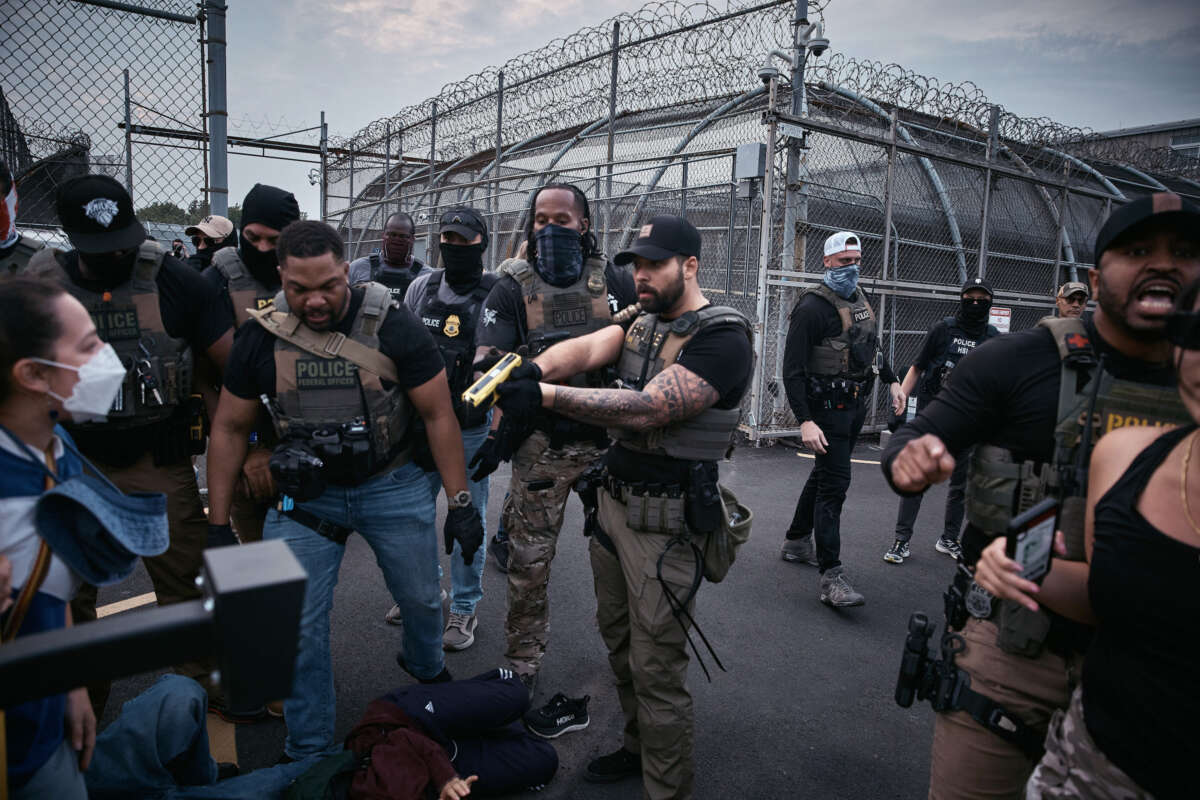
New Jersey Attorney General Matt Platkin called the ruling disappointing and noted the recent controversies at Delaney Hall, an immigration jail in Newark run by private prison company GEO Group. Protesters have been outside the jail for months, decrying the lock-up’s inhumane conditions. In May, federal agents arrested two Democratic politicians, Newark Mayor Ras Baraka and New Jersey Congresswoman LaMonica McIver, outside the jail.
“As recent events at Delaney Hall underscore, entrusting detention to for-profit companies poses grave risks to health and safety, and as the dissenting judge noted, States retain broad latitude to protect the health and safety of people within their borders — particularly where, as here, there is no conflict with federal legislation,” Platkin said in a statement posted on the attorney general’s website.
The New Jersey attorney general’s office told Truthout in an email that it is still evaluating if the office will appeal the decision.
Advocates quickly condemned the federal court’s ruling.
“Today’s ruling by the Third Circuit is a devastating blow to immigrant communities in the Garden State,” said ACLU-NJ Staff Attorney Molly Linhorst in a press release. “It has been widely proven that private immigration detention facilities are rampant with abuse, dangerous conditions, and medical neglect, presenting a critical threat to public health.”
Nedia Morsy, director of immigrant advocacy group Make the Road NJ, said in a statement that the ruling “makes New Jersey the epicenter of family separation, kidnapping, and the disappearance of our loved ones.”
The court’s decision is undoubtedly good news for the private prison industry, which has already had much to celebrate.
In May CoreCivic’s CEO told investors, “I would like to share how excited I am for and deeply proud of our team here at CoreCivic.”
“Never in our 42-year company history have we had so much activity and demand for our services as we are seeing right now,” he said.
Shortly after taking office, Trump signed the Laken-Riley Act, which requires mandatory detention of undocumented immigrants who are charged with a variety of offenses, including shoplifting. ICE has estimated that the new law could require an additional 110,000 beds.
Trump’s so-called One Big, Beautiful Bill, signed into law on the Fourth of July, provides an additional $170.7 billion in funding for immigration and border enforcement actions. Of the total amount, approximately $45 billion is for building new immigration jails, including ones designed to hold families.
“The overwhelming majority of the funding for ICE detention will likely go to private companies contracted to build and run detention facilities,” the American Immigration Council stated in its analysis of the bill.
According to a July filing with the Securities and Exchange Commission, GEO Group approved raises for its CEO and chairman because of the “unprecedented business opportunities that the Company is experiencing.” Their target bonus and target stock award are increasing from 100 percent to 150 percent of their base salary. The chair’s base salary is $1.1 million and the CEO’s is a million.
On the company’s quarterly earnings call in May, GEO Group’s CEO told investors that the company is “very excited to support the mission at hand.”
Important Message: Please Read
For 25 years, Truthout has survived by publishing impactful investigative journalism and analysis; distributing full editions 365 days a year; and building a community of readers who support us with small, hard-earned donations.
Eighty percent of our $3 million yearly budget comes from small donors alone. Of those, 8,000 readers support us with monthly donations. Back in 2018, when Facebook decided to suppress the circulation of posts made by organizations, thereby cutting readers off from seeing many articles shared by the news organizations they had intentionally decided to follow, Truthout’s total traffic declined by 40 percent, as nearly all of our traffic from that platform disappeared.
Now, Google has recently rolled out its AI search bar, providing AI summaries instead of directing readers to our site. Google Search is our single largest source of traffic; it’s the route by which nearly one third of our readers find us. Much like in 2018, a shocking 40 percent of our Google traffic has disappeared overnight.
It will not be easy for Truthout to shoulder this blow. Nor will it be easy for our peers and collaborators — news sites that depend on traffic and aren’t bankrolled by large corporations.
If you can support Truthout with a donation today, you can help us resist the AI onslaught. Please give today.